 Construction companyDmitry Evtushenko
RU · EN · DE
Get an estimate
Construction companyDmitry Evtushenko
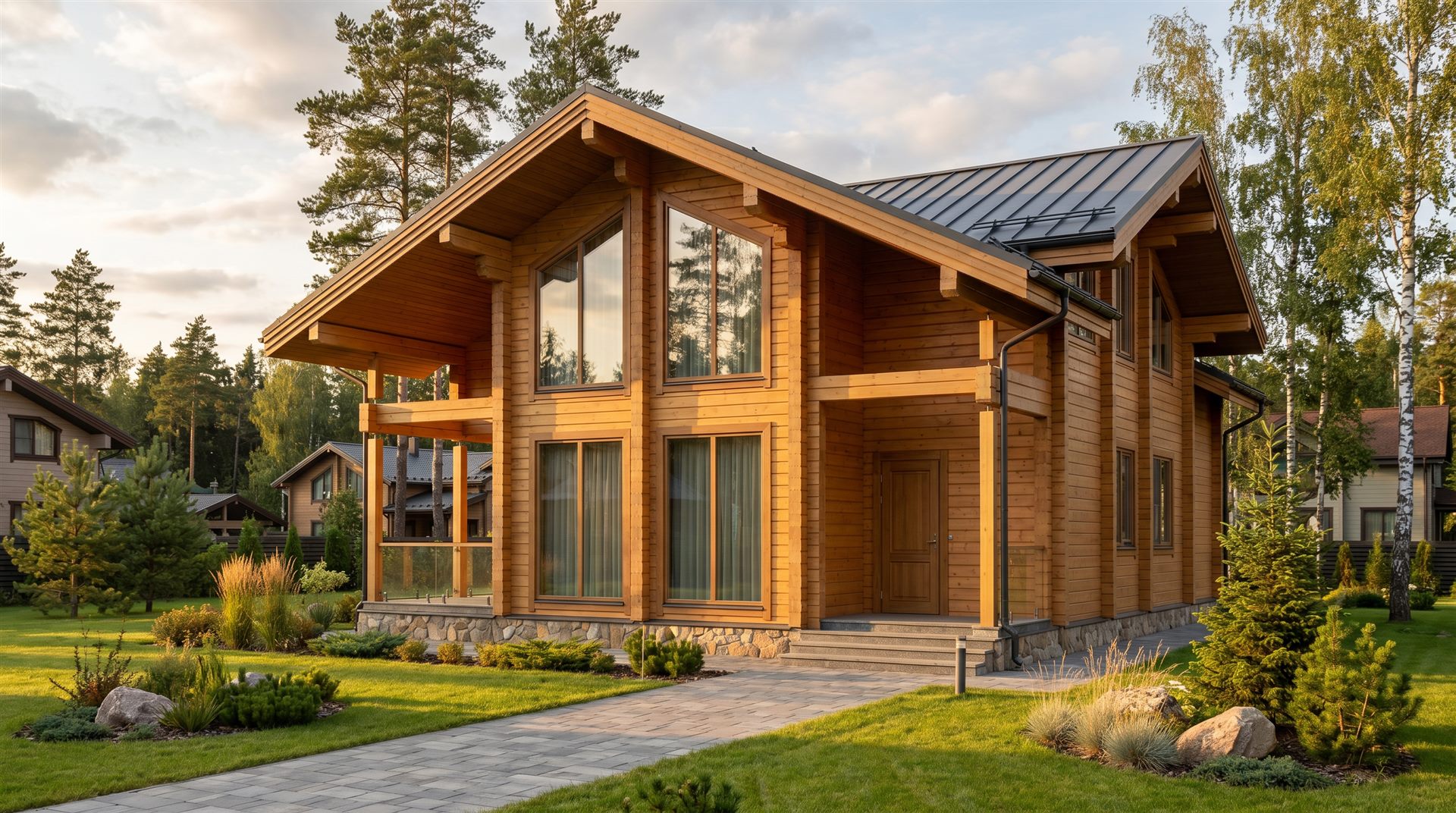
Premium timber: a warm home with minimal shrinkage — you move in almost straight away, with no long wait. The grain of the wood is there in the interior, so the walls need no internal finish at all.
Honestly: glulam isn’t the “best” material, nor the worst. It’s the best at what it does. Here’s when it’s your option — and when I’ll suggest something else.
A warm house for year-round living, with “breathing” timber walls and a healthy indoor climate.
You want to see the grain inside with no finish over it — the wall is ready as it stands, warm to the touch and to the eye.
A home that looks expensive and genuinely natural — glulam holds its geometry and doesn’t warp.
Glulam is premium timber, and it’s priced accordingly. I choose it for the warmth and the beauty of the wood. If the budget is tight, I’ll tell you straight that masonry will work out cheaper.
With glulam, three things make the house: the quality of the timber itself, a warm interlocking joint and proper protection of the wood. This is where corners get cut most often — and where I don’t economise. Crews specialised for each stage do the work under my personal supervision, and I sign off every stage myself.
* indicative, depending on the design; exact figures follow the site visit
The lamellas are kiln-dried to 10–12% moisture content, then bonded into quality beams. I check the incoming timber myself — whether a wall stays true or warps depends on it.
The warm interlocking profile goes together without any sealing tape between courses — the joint simply doesn’t let draughts through. The crew assembles it under my supervision and I sign off every course.
Shrinkage is only 1.5–2%, but it still has to be designed for: sliding fixings and sliding casing frames around windows and doors. Then nothing gets pinched and nothing cracks.
Wood preservative, an oil-based stain, ventilation gaps. Timber needs to breathe and stay dry — then it lasts for decades. I choose the products and the maintenance schedule to suit your house.
Something almost nobody shows you. Here is the wall build-up from the inside out — every layer with a job to do. Once you can see the section, you understand what you’re paying for and why the house will be warm.
Often the wall needs no additional insulation at all. The exact build-up is set by your design. This is a typical solution for year-round living.
Every material has its limits. Hiding them means letting you down later. Here it is as it stands.
A table hardly anyone else will show you. Compare them side by side and decide on the facts, not the advertising.
| Material | Warmth | Price | Speed | Shrinkage | Service life |
|---|---|---|---|---|---|
| Aerated concrete | high | medium | fast | none | 80+ years |
| Brick | medium | high | slow | none | 100+ years |
| Glued laminated timber | high | high | fast | 1.5–2% | 100+ years |
| Ceramic block | high | medium+ | fast | none | 100+ years |
These ratings are indicative, for a quick comparison. Exact performance is set by the specific design.
Not one “from” figure, but a breakdown by stage — so you can see what you’re paying for. That way you know where it’s sensible to economise and where it isn’t.
Price it up for my homeThe ₽/m² rate depends on floor area, number of storeys and whether there’s a basement — and it falls as the house gets bigger. For a figure specific to your home, use the calculator; the final estimate follows a visit to your plot.
Tell me about your plot and how many rooms you need, and I’ll work out a ballpark estimate and timeline. You write to me personally, and I answer personally. The site visit is free.